To answer how do i make a furnace in minecraft, collect 8 cobblestone, open a crafting table, and place the blocks in every slot except the center. Take the furnace from the result slot, place it, then add an item to smelt in the top slot and fuel in the bottom slot. ([learn.microsoft.com](https://learn.microsoft.com/en-us/minecraft/creator/reference/content/recipereference/examples/recipedefinitions/minecraftrecipe_furnace?view=minecraft-bedrock-stable&utm_source=openai))
What you need to craft a furnace
The basic furnace recipe is one of the first useful crafts in a new survival world. You need a crafting table and eight pieces of cobblestone. Cobblestone comes from mining stone with a pickaxe, and a wooden pickaxe is enough to collect it.
- 1 crafting table
- 8 cobblestone
- Fuel, such as coal, charcoal, wood, or wooden planks
You do not need iron, glass, coal, or a special tool to craft the furnace itself. Coal is only needed later when you want to run it, and you can use several other fuel items if you have not found coal yet.
How do i make a furnace in minecraft
| Ingredient | Quantity | Where it goes |
|---|---|---|
| Cobblestone | 8 | All eight outer slots of the 3x3 grid |
| Center slot | Empty | Leave the middle slot blank |
| Result | 1 furnace | Collect it from the output slot |
The layout is simple: place three cobblestone across the top row, two cobblestone on the left and right sides of the middle row, and three cobblestone across the bottom row. Leave the center slot empty. The pattern looks like a hollow square.
Craft the furnace step by step
- Open your crafting table to use its 3x3 crafting grid.
- Place eight cobblestone around the outside of the grid.
- Leave the center slot empty.
- Move the furnace from the result box into your inventory.
You can also use the recipe book if it is unlocked. Put the required cobblestone in your inventory, find the furnace recipe, and select it. If the recipe does not appear, place the blocks manually using the hollow-square pattern.
How to get a furnace without crafting one
Crafting is usually the fastest way to get your first furnace, but you can also find furnaces in some naturally generated locations, including village buildings. To collect a placed furnace, mine it with a pickaxe. Breaking it without a pickaxe does not reliably give you the furnace as an item.
Once you have one furnace, you can move it whenever necessary. Place it near your shelter, mine, storage room, or farming area so you spend less time carrying raw materials back and forth.
In survival, eight cobblestone is normally easier to obtain than searching for a generated structure. Mine stone underground or into a hillside, then use the cobblestone that drops to make the furnace.
How to use a furnace in Minecraft
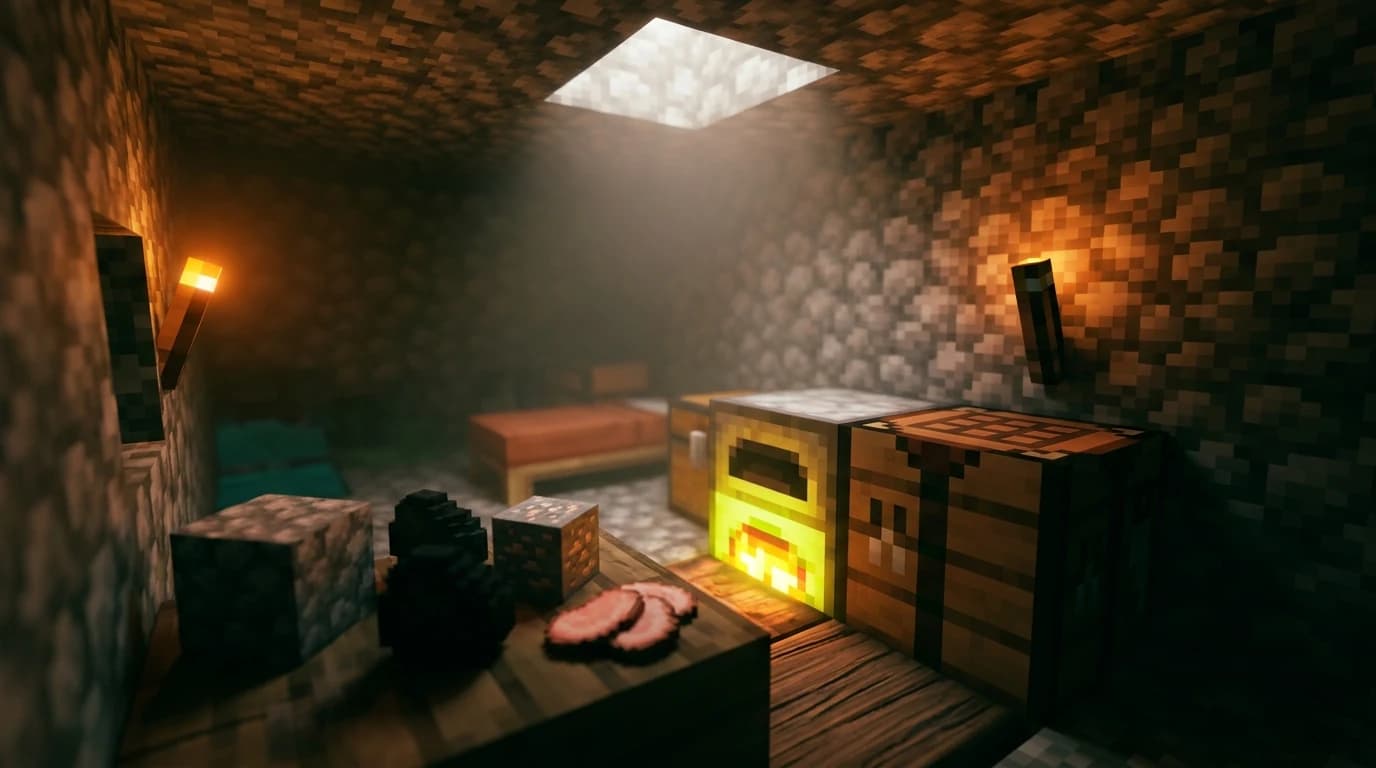
A furnace has three important slots: the input slot at the top, the fuel slot at the bottom, and the output slot on the right. The input is the item you want to process. Fuel powers the furnace, and the finished item appears in the output slot.
Load and start the furnace
- Place the furnace on a solid block or another suitable surface.
- Open the furnace interface.
- Put a smeltable or cookable item in the top slot.
- Put fuel in the bottom slot.
- Wait for the progress arrow to finish.
- Take the finished item from the output slot.
The furnace only starts when both the input and fuel slots contain compatible items. The flame icon shows the remaining fuel, while the arrow shows the progress of the current operation. If you remove the input before it finishes, the item remains unchanged rather than becoming a partially processed item.
What a furnace can do
A furnace handles many basic survival jobs. It can process ores, cook food, make glass, create stone variants, and turn certain raw materials into useful crafting ingredients.
- Smelt iron, copper, gold, and other furnace-compatible ores or raw materials.
- Cook raw meat and fish into safer food.
- Smelt sand into glass.
- Smelt cobblestone into stone.
- Burn logs into charcoal.
- Process clay and other materials into their finished forms when a furnace recipe exists.
A regular furnace is the most flexible smelting station. A smoker cooks food faster, while a blast furnace processes ores and metal-related items faster, but those specialized blocks cannot replace the regular furnace for every recipe.
Choosing fuel for your furnace
Coal and charcoal are dependable early-game fuel because each piece can smelt or cook eight items. Wooden planks, logs, sticks, wooden tools, and other burnable items can also work, although their efficiency varies. A lava bucket lasts much longer than most basic fuel, but it is more valuable and leaves an empty bucket after burning.
- Coal or charcoal: A strong general-purpose choice for early survival.
- Wood and wooden planks: Useful when you have not found coal.
- Wooden tools: A practical way to use old tools after upgrading.
- Lava bucket: Long-lasting fuel for large smelting jobs.
Match the fuel amount to the job. If you only need one cooked meal or a few glass blocks, do not use a large fuel source unnecessarily. For bigger jobs, place enough input items and fuel in the furnace before leaving so it can continue working while you explore or gather resources.
Java Edition and Bedrock Edition differences
The basic furnace recipe and operation are the same in Java Edition and Bedrock Edition: use eight compatible stone blocks around an empty center slot, then place the item and fuel into the furnace interface. The main difference you notice is the control layout, which depends on whether you play with a keyboard, controller, or touchscreen.
The safest material for the recipe is cobblestone because it is easy to find and works across current editions. Some versions also accept compatible alternatives such as blackstone or cobbled deepslate. If the recipe book shows a different stone variant, you can still manually try eight cobblestone in the same hollow-square pattern.
On PC, right-click the crafting table or furnace to open it. On consoles and mobile devices, use the platform’s interact button or tap the block. The slots and furnace functions remain the same even though the buttons differ.
Common furnace crafting and usage mistakes
If the furnace recipe is not producing a result, check the grid before collecting more materials. The most common problem is placing cobblestone in the center or trying to use a 2x2 personal crafting grid. A furnace requires the 3x3 grid inside a crafting table.
- Use eight cobblestone, not seven or nine.
- Leave the middle slot empty.
- Craft it at a crafting table, not in the player’s 2x2 grid.
- Put the raw material in the top furnace slot.
- Put fuel in the bottom furnace slot.
- Make sure the item is compatible with a regular furnace.
- Collect finished items from the output slot before it fills up.
If the furnace is not burning, the input may not be smeltable, the fuel may be missing, or the output slot may be full. If the furnace stops after one item, add more fuel or check whether the available fuel has been completely consumed.
What to craft after your first furnace
Your first furnace unlocks several important survival upgrades. Smelt iron for buckets, shields, tools, armor, and other equipment. Cook a supply of food before traveling far from your base, and turn sand into glass for windows or future builds.
Once your workload grows, craft additional furnaces instead of waiting for one block to finish every job. You can run several furnaces at the same time, dedicate one to food, another to ores, and another to building materials. Later, add a smoker or blast furnace when you want faster cooking or faster ore processing.