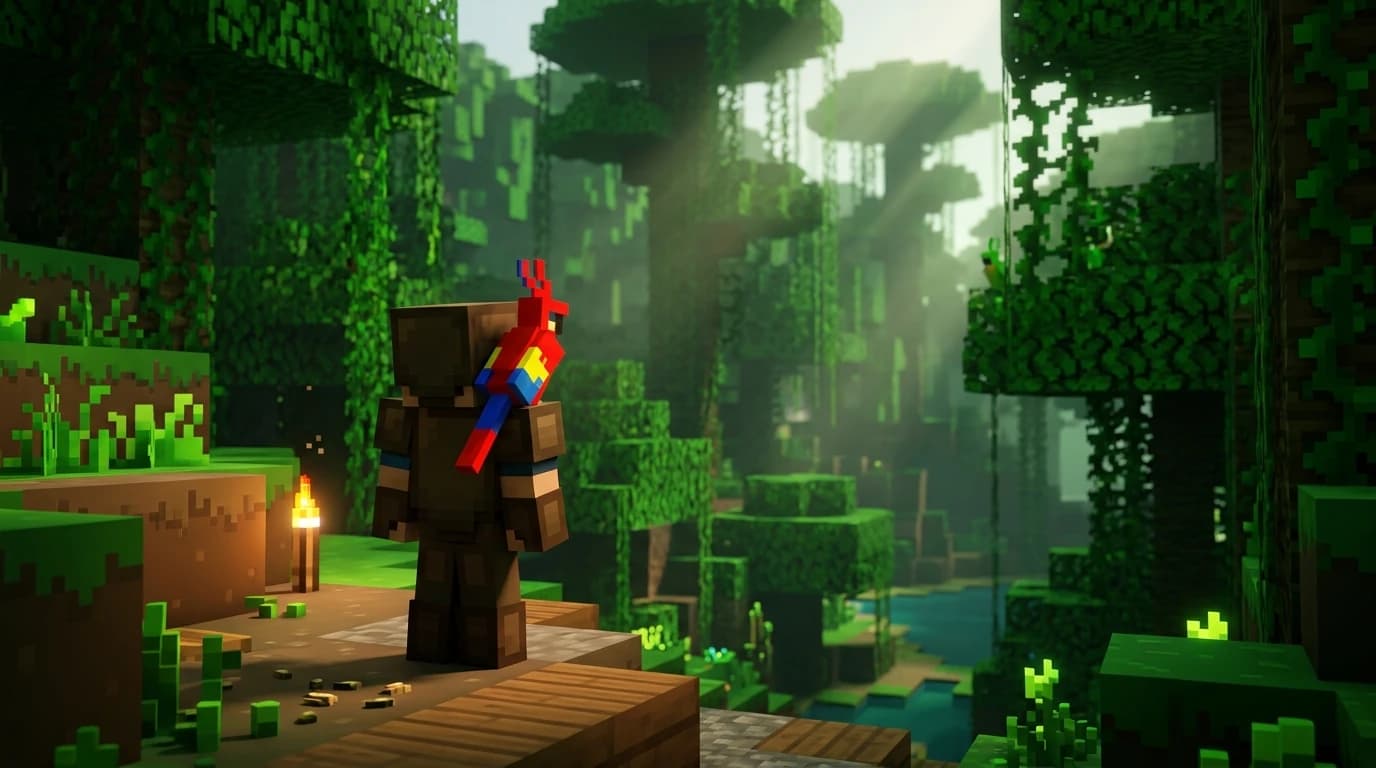
To learn how to tame a parrot Minecraft players need to find one in a jungle, then use wheat seeds, melon seeds, pumpkin seeds, beetroot seeds, or torchflower seeds on it. Each seed has a 10% chance to tame the parrot, so bring a stack or more. Hearts appear when taming succeeds, and the bird follows you afterward. ([minecraft.fandom.com](https://minecraft.fandom.com/wiki/Parrot?utm_source=openai))
Where to find parrots in Minecraft
Parrots spawn naturally in jungle environments, including regular jungle, sparse jungle, and bamboo jungle areas. They are passive flying mobs, so they do not attack you, but dense leaves and tall jungle trees can make them difficult to spot.
Search the ground, tree trunks, leaves, and open spaces beneath the canopy. Parrots can fly and may move between branches, so listen for their calls as you explore. A jungle is usually the only place you need to search in Survival mode; outside a jungle, you generally need a spawn egg or command to create one.
What to bring before searching
- At least one stack of usable seeds, preferably several types.
- A lead or boat if you want to move an untamed parrot safely.
- Blocks for crossing gaps and climbing through the canopy.
- Food, tools, and shelter for the jungle trip.
Wheat seeds are usually the easiest option because breaking grass supplies them. Melon, pumpkin, and beetroot seeds also work. Torchflower seeds work as well in current versions, giving you another option if you already grow torchflowers.
How to tame a parrot in Minecraft
Taming uses seeds rather than a special item or crafting recipe. You do not need to weaken the parrot first, and you cannot tame it by placing it in a cage. Approach slowly, select a compatible seed, and use it on the bird.
- Find a parrot in a jungle, sparse jungle, or bamboo jungle.
- Place wheat seeds, melon seeds, pumpkin seeds, beetroot seeds, or torchflower seeds in your hotbar.
- Approach the parrot and use the selected seeds on it.
- Continue feeding seeds until heart particles appear.
- Use the parrot again after taming to make it sit or stand.
Every seed has a 10% chance to tame the parrot, so success is random. You may tame one with a single seed, or you may need several attempts. The seed is consumed when you use it, including attempts that do not succeed. ([minecraft.fandom.com](https://minecraft.fandom.com/wiki/Parrot?utm_source=openai))
Once tamed, the parrot follows you when it is standing. It can also teleport to you when it gets far enough away, which helps prevent it from being permanently lost during normal travel.
How to feed a parrot in Minecraft
Use seeds to tame an untamed parrot, but do not treat parrots like cows, sheep, or wolves that need regular feeding. Tamed parrots do not have a normal breeding or feeding routine, and seeds are mainly used for the taming interaction.
Never feed a parrot a cookie. Cookies are poisonous to parrots. In Java Edition, a cookie kills the bird immediately. In Bedrock Edition, it applies fatal poison instead, which also results in the parrot's death. This behavior exists because chocolate is toxic to real parrots. ([minecraft.fandom.com](https://minecraft.fandom.com/wiki/Parrot?utm_source=openai))
If you are trying to interact with a tamed bird, use an empty hand to change whether it sits. If you hold seeds near it, avoid accidentally using them unless you are still taming an untamed parrot.
How parrots use your shoulder
A tamed parrot can perch on your shoulder, giving you a colorful companion that travels with you without taking a normal mob-leash position. Make the parrot stand, then walk through it. The bird may move onto one of your shoulders automatically.
You can carry up to two tamed parrots, one on each shoulder. Shoulder parrots can fall off when you take damage, jump or fall in certain situations, enter water, sleep, or move through conditions that make the bird dismount. Check your shoulders after combat, climbing, and long journeys.
Parrots also imitate nearby hostile and neutral mobs. Their sounds can warn you that a dangerous mob is close, although the imitation does not always mean the mob is directly beside you. A tamed parrot can also dance near a jukebox when music is playing, making it a useful decorative companion for a base.
Can you breed parrots in Minecraft?
No, vanilla Minecraft does not let you breed parrots. There is no parrot breeding item, no baby parrot, and no combination of seeds that produces offspring. Feeding seeds only gives you chances to tame an untamed bird.
The advancement named “The Parrots and the Bats” does not mean parrots can breed. It is a title for an advancement involving breedable animals, while parrots and bats themselves remain non-breedable mobs. ([minecraft.wiki](https://minecraft.wiki/w/Talk%3AParrot?utm_source=openai))
If you want multiple parrots, you must find and tame each one separately. Keep the birds sitting while you search for another, or transport them carefully with a lead, boat, or by allowing tamed birds to follow you.
What is the rarest parrot in Minecraft?
Minecraft has five parrot color variants: red, blue, green, cyan, and gray. No variant is officially the rarest in normal gameplay. The color is selected when the parrot spawns, and you cannot change a parrot's color after taming it.
Because parrots are limited to jungle biomes and can be difficult to locate, a particular color may feel rare on your world. That is usually a result of random spawning and the number of birds you have found, not a different taming chance or special spawn rule.
- Red: one of the standard natural variants.
- Blue: a popular choice for matching ocean or diamond-themed builds.
- Green: blends into jungle foliage more easily.
- Cyan: stands out against dark leaves and wood.
- Gray: has a muted color scheme that fits stone builds.
All five variants behave the same way. Color does not change health, taming odds, shoulder behavior, sounds, or movement.
Java Edition and Bedrock Edition differences
The basic process is the same in Java Edition and Bedrock Edition: find a parrot in a jungle, feed it compatible seeds, and repeat until hearts appear. Both editions have the same five main color variants and both prevent normal parrot breeding.
The major practical difference concerns cookies. Feeding one to a parrot kills it in Java Edition, while Bedrock Edition applies fatal poison. Either way, the bird dies, so cookies should never be used as parrot food. ([minecraft.fandom.com](https://minecraft.fandom.com/wiki/Parrot?utm_source=openai))
Protecting and moving a tamed parrot
Parrots are fragile companions, so make their home safe before bringing one back from the jungle. They can wander into hazards, fly toward hostile mobs, and take damage during dangerous exploration.
- Use the interaction button on the bird to make it sit inside your base.
- Build a roof or enclosed aviary so it cannot fly into lava, fire, or deep caves.
- Keep parrots away from campfires, magma blocks, and open water.
- Use name tags if you want to identify several birds by color or role.
- Make the parrot stand only when you want it to follow you.
A sitting parrot stays in place until you tell it to stand. This is the safest way to keep a collection of different colors at home. If you are traveling, let the bird follow only through routes that do not include lava, steep drops, or active combat.
Common parrot-taming mistakes
- Using cookies: cookies are lethal, not a taming item.
- Stopping after one seed: each attempt has only a 10% success chance.
- Looking only on the jungle floor: parrots can perch on leaves and tree branches.
- Expecting breeding: every additional parrot must be found and tamed separately.
- Leaving the bird standing: make it sit before exploring dangerous areas.
- Assuming color affects ability: all five variants have the same behavior and stats.
The fastest reliable approach is to locate a jungle, gather plenty of wheat seeds from grass, and tame the first parrot you find before searching for a preferred color. Once you have your bird, keep it sitting at home until you are ready to use it as a shoulder companion.